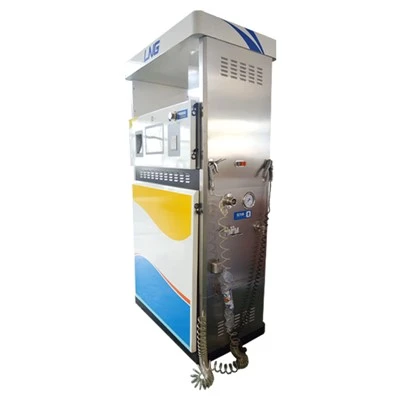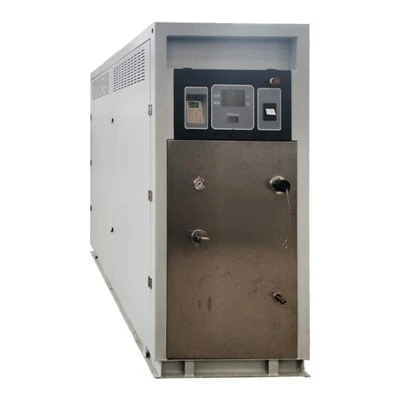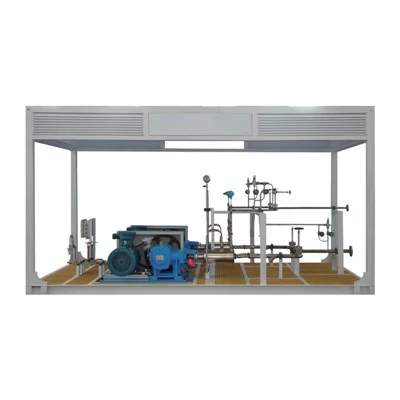

The Single Pump LNG Cryogenic Pump Skid is a factory-assembled LNG transfer and pressurization system integrating a submerged cryogenic pump, insulated process piping, valves, and PLC controls on a compact skid for small and medium LNG refueling stations.
Parameter Specifications
| 1. Applicable medium | Liquefied natural gas (LNG) |
| 2. Dimensions (length x width x height) | (4000 * 2250 * 2540mm) |
| 3. Design head | 220-28Dm |
| 4. Design speed | 5800r/min |
| 5. Design flow rate | 360L/min |
| 6. EAG heater | 150Nm/h |
| 7. Turbocharger | 200Nm ² m |
| 8. Pressure test before/after pressure pump | 1.84/2.88Mpa |
| 9. Air tightness test pressure before/after pump | 1.6/2.5Mpa |
| 10. Design pressure pump before/after | 1.6/2.5Mpa |
| 11. Working pressure before/after the pump | 1.0/1.6Mpa |
| 12. Design temperature | -196 ℃ |
| 13. Working temperature | -162 ° C |
| 14. Pipeline flange common pressure | 4.0Mpa |
| 15. Motor power | 11KW/15KW |
| 16. Power supply | Three-phase 380V50HZ |
| 17. Weight | Approximately 3000kg |
| 18. LNG low-temperature pump pry (single pump) supports the operation of 2 single gun liquid dispensers |
Key Product Advantages
Stable LNG Transfer
The submerged cryogenic pump delivers up to 360 L/min with a head of 220–280 m, providing stable LNG supply for continuous vehicle refueling while minimizing pressure fluctuations.
Factory-Assembled
All piping, valves, electrical wiring, and control components are pre-installed and tested before shipment. Only foundation fixing, utility connections, and commissioning are required on site, significantly reducing installation time.
Lower Maintenance Requirements
The submerged pump operates completely immersed in LNG, eliminating mechanical shaft seals that are common leakage points in conventional pump systems. Fewer wearing components help reduce maintenance frequency and station downtime.
Designed for Long-Term Cryogenic Operation
The skid is engineered for -196°C LNG service with cryogenic stainless-steel piping and insulated process components, ensuring reliable operation under repeated thermal cycling.
Customization Capabilities
|
Option |
Available Choices |
|
Pump Capacity |
According to station throughput |
|
Motor Voltage |
380V / 400V / 415V / 440V / 480V |
|
Frequency |
50 Hz / 60 Hz |
|
PLC Brand |
Siemens / Schneider / ABB |
|
HMI Language |
English / Spanish / Russian / Arabic |
|
Communication Protocol |
Modbus TCP / Modbus RTU / Ethernet |
|
Hazardous Area Rating |
According to local regulations |
|
Piping Connection |
Customized flange standards |
Target Applications
LNG satellite stations
Public LNG fueling stations
Private fleet fueling facilities
Heavy-duty truck fueling
Mining vehicle fueling
Industrial LNG transfer systems
Manufacturing & Factory Testing
Incoming material inspection
Skid frame fabrication
Cryogenic piping welding
Pressure testing
Leak detection
Electrical inspection
PLC functional testing
Factory Acceptance Test (FAT)
Packaging & Logistics
Base Mounting: Heavy-duty steel base structurally designed for crane lifting and ocean container/flat-rack transport.
Weather & Corrosion Protection: Multi-layer moisture-proof protective wrapping covering all exposed instruments, valves, and control panels.
Vibration Dampening: Internal mechanical components secured against transport-induced shock and dynamic loads.
Project Documentation: Complete technical package included with shipment (GA drawings, P&ID diagrams, electrical schematics, material test reports, FAT records, and installation/operation manuals).
After-Sales & Technical Support
Engineering Support
P&ID review before production
Foundation drawing confirmation
Layout verification
Commissioning Assistance
Remote startup guidance
PLC parameter configuration
Alarm troubleshooting
Spare Parts Support
Standard spare parts inventory
Long-term component supply
Technical documentation update
FAQ
Q: How do I choose between a single-pump and a dual-pump LNG skid?
A: A single-pump skid is generally suitable for stations with moderate daily fueling demand or dedicated fleet operations. Dual-pump systems provide standby redundancy and higher throughput for busy public stations or future capacity expansion.
Q: What information is required before requesting a quotation?
A: To recommend the correct configuration, suppliers typically require daily LNG consumption, number of dispensers, storage tank size, local power supply, hazardous area classification, and project location.
Q: Can this skid be upgraded if station demand increases?
A: Yes. Depending on the original station layout, piping design, and control architecture, the system can be planned to allow future expansion with additional dispensers or conversion to a dual-pump configuration.
Q: What routine maintenance is required for the pump skid?
A: Routine maintenance mainly includes checking insulation performance, valve operation, electrical connections, PLC alarms, and instrument calibration. Maintenance intervals vary according to operating hours and local operating conditions.
Q: What spare parts are normally recommended with the initial order?
A: Many operators purchase commonly used spare parts such as pressure transmitters, temperature sensors, cryogenic valves, seals, PLC I/O modules, and electrical protection devices together with the skid to minimize future downtime.
Q: How long does factory testing take before shipment?
A: Each skid completes pressure testing, leak testing, electrical inspection, PLC functional verification, and factory acceptance testing before shipment. The testing schedule depends on project configuration and customer witness requirements.
Q: Can engineers support installation and commissioning overseas?
A: Yes. Remote commissioning support is available for standard projects, while on-site engineering services can also be arranged according to project requirements.
Q: What factors affect the delivery lead time?
A: Lead time mainly depends on pump specification, electrical component brands, explosion-proof requirements, project customization, and current production schedule. Standard configurations generally have shorter manufacturing cycles than highly customized systems.
Hot Tags: single pump LNG cryogenic pump skid, China single pump LNG cryogenic pump skid manufacturers, suppliers, factory, lng filling dispenser, lng fueling system, lng mass flow meter, lng pump process skid, lng pump skid assembly unit, lng pump skid temperature range